


The Challenges of Writing About a Māori Icon from a Non-Māori Perspective
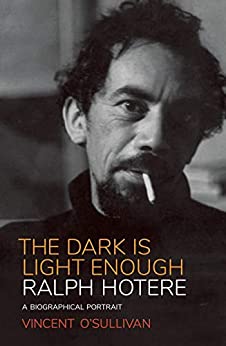
Vincent O’Sullivan’s biography of Ralph Hotere won the 2021 Ockham New Zealand Book Award for general nonfiction.
By Todd Nicholls, Australasian Correspondent
One of New Zealand’s finest biographers has recently published a biography of the New Zealand artist Ralph Hotere. That may in itself not seem unusual, however, the publication is somewhat unusual in that the biographer is New Zealand-European and the subject is not only Māori but symbolic of Māori enlightenment in 20th-century New Zealand.
Vincent O’Sullivan, author of The Dark Is Light Enough: Ralph Hotere, A Biographical Portrait, is one of New Zealand’s most respected senior writers. His resumé reads like a timeline of the most significant events in modern New Zealand literature. A poet, short story writer, novelist, playwright, critic, editor, biographer, and librettist, O’Sullivan’s professional credentials cannot be questioned. However, O’Sullivan is the first to admit that writing about a Māori icon as a non-Māori was indeed challenging.
“I’d known Ralph since we were in our early twenties when we were both studying in England,” said O’Sullivan. “We didn’t talk about art back then. We would do things like going to watch the rugby at Twickenham.
“However, after I’d published a recent biography of the writer, soldier, and publisher John Mulgan, Ralph approached me and asked whether I’d be interested in writing a biography of him. This was shortly after his stroke. He knew that a biography would be written. It was good that we were friends, but it was also good that we weren’t close friends. I said yes to writing the biography. So we went from there.”
O’Sullivan said that when they first discussed the biography, he was clear with Hotere that he was neither an art expert nor Māori. “He told me that neither of these facts were relevant. What he wanted was someone who would write [the biography] without an agenda.”
O’Sullivan made Hotere’s wish known in the preface of the biography. He said without doing so he may have been criticized for not being “qualified” to write it.
O’Sullivan did have some knowledge of Hotere’s background: his wife at the time was also Māori from the same part of the country as Hotere. However, he said, he was no more than “a casual observer” about broader Māori issues at the time.
O’Sullivan said that matters of ethnicity never came into writing the biography. “Because I had Ralph’s backing [in writing the biography], finding stuff out was never an intrusive problem. What helped in this regard was, first, that I had the blessing of Ralph’s community and, secondly, I tried to obtain as much relevant knowledge of Ralph’s background and what influence it had on his life. The result was that I didn’t really think about the differences between us.”
While O’Sullivan appreciates that others (some of whom are likely to be Māori) will also write about Hotere in the future, he said that for now his biography has added to the public’s understanding of the artist. “This is a book that we needed because if I hadn’t done it there are at least 30 people who I spoke to [including two of Ralph’s sisters] who have since died. I therefore see it as an essential platform for a biography, but I don’t see it as being in any sense an attempt at a finalized biography.”
Like many biographers of creative people, O’Sullivan had to walk a fine line between Hotere’s life and his art. With respect to the images that he wanted to use, he provided Hotere with a list (Hotere had told him to write whatever he wanted and to use whatever images he wanted). By the time O’Sullivan had done this, Hotere was incapacitated by his stroke and his Power of Attorney had come into effect. The request was therefore interpreted as though O’Sullivan was requesting permission from the Hotere Trust, ignoring the fact that Hotere himself already had given him a free hand to use any images he wished. After protracted and unsatisfactory exchanges between the publisher and the Trust, the biography was abandoned for several years, and not taken up again until just before the COVID lock-down. O’Sullivan felt that he owed it to Hotere to finish his “portrait,” whatever the spanners thrown into its original planning. The Trust put limits on the images that could be included, which meant O’Sullivan had to write about those images rather than simply reproduce them. O’Sullivan said, “It is not art writing in a strict sense. But it is an attempt to explain to a reader what kind of art [Hotere] was doing at what time and for what reasons.”
The Dark Is Light Enough has received significant acclaim. O’Sullivan said that it was a difficult book to write, in part because of the lack of images he wanted to include. The biography finishes in 2001, after Hotere had a stroke. “To me when Ralph had his stroke it was the end of his time as an artist. I know that some people don’t agree with this, but I thought that was the end of my responsibility in writing about the artist,” O’Sullivan said.
O’Sullivan said that having Hotere’s family and some of his readers (including some Māori artists) look over the text assisted him in writing accurately about Hotere. “Everyone was extremely helpful. Of the 60 people I interviewed there was only one person who had a bad word to say about Ralph. And I later found out that [person] was an art dealer who had earlier stolen some of Ralph’s work. I never experienced any ill-feeling amongst the Māori I spoke to. The overwhelming feeling was happiness that somebody was writing a biography about Ralph.”
Todd Nicholls is a barrister, writer, and journalist based in Christchurch, New Zealand. He is passionate about biography. He is currently writing a biography of a prominent New Zealand sportsperson.