|
November 2021 | Volume 16 | Number 9
|
|
|
FROM THE EDITOR
I hope this edition of The Biographer’s Craft finds you well-rested and content. Many of us have likely just entered our holiday season, and you may either be enjoying some downtime or gearing up for a round of hosting and merrymaking.
With both of those possibilities in mind, I have compiled a special roundup of soundbites from recent episodes of the Bio podcast, which is produced with great dedication and talent by a committee of BIO members. Whether you are comfortably at home or on the go, you may find it a good opportunity to listen to some inspired thinkers and writers discussing the craft we hold so dear.
While we reflect on the people, places, and activities we are grateful for, I offer a friendly reminder on behalf of the organization that Giving Tuesday is November 30. Please give to BIO as generously as you can. I am wishing you and yours peace, health, and good spirits.
Best Regards,
Holly Van Leuven
|
|
|
|
A ROUNDUP OF INSIGHTS FROM BIO’S PODCAST THIS FALL
Did you know that BIO produces Bio—a podcast dedicated to promoting the art of biography and the craftspeople who write them? The podcast is run by BIO’s Podcast Committee, which consists of Sonja D. Williams (chair), John A. Farrell, Kitty Kelley, and Eric K. Washington. New episodes appear biweekly, each one featuring a BIO member interviewing a colleague about their recent work. These episodes offer interesting insights into the interviewee’s subject matter expertise and various elements of craft, such as writing, interviewing, and piecing together archival information. If you are not in the habit of listening to the podcast, you may want to give an episode of Bio a try.
For the month of December, Bio will release new episodes every Friday. These will be edited versions of the panels from BIO’s 2021 Conference. To find these and other episodes, you can visit the BIO website, Google Podcasts, or Apple Podcasts.
Below you will find a roundup of insights offered by guests of the podcast this fall, as well as links to the episodes from which they came.
|
On Innovative Structures
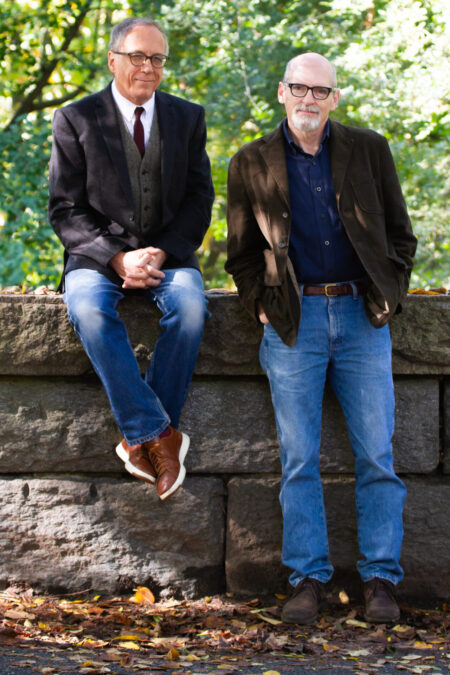 Hajdu (left) and Carey (right)
David Hajdu and John Carey, authors of A Revolution in Three Acts: The Radical Vaudeville of Bert Williams, Eva Tanguay and Julian Eltinge
Hajdu and Carey were interviewed by Eric K. Washington about their innovative group biography of three important figures from Vaudeville. Carey, an illustrator, contributed the types of illustration panels frequently seen in graphic novels and comic books. Hajdu explained that this allowed the collaborators to “slow down and linger” on dramatic moments. At the same time, “comics gave us a kind of license to dramatize events that aren’t documented. We know, for instance, that Julian Eltinge collected antiques. We can have a few comics panels where he’s shopping for antiques…we can give life to the historical fact…and readers know, ‘Those are in a comics panel and there’s word balloons now,’ so they take that to be a reenactment. Something like seeing the reenactments in a documentary. …It’s a convention of the form.” FULL EPISODE
On Research that Moves Cultures
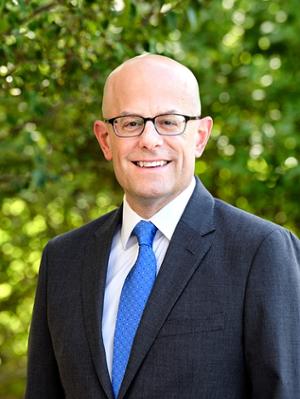
Ty Seidule, author of Robert E. Lee and Me: A Southerner’s Reckoning with the Myth of the Lost Cause
Ty Seidule grew up revering Robert E. Lee. From his southern childhood to his service in the U.S. Army, every part of his life reinforced the Lost Cause myth: that Lee was the greatest man who ever lived, and that the Confederates were underdogs who lost the Civil War with honor. Now, as a retired brigadier general and Professor Emeritus of History at West Point, his view has radically changed. From a soldier, a scholar, and a southerner, he believes that American history demands a reckoning. Kitty Kelley interviewed Seidule, who said: “I don’t want to have less history. I want to have more. I want to have those stories that were hidden from me as a child growing up in Virginia and Georgia to be talked about. …I raised my right hand, gave the oath of office, and became an Army officer. And that wasn’t my identity when I first came in. I was a Virginia gentleman. …I went into the archives and what I found is what changed me. What I found was that in the nineteenth century, West Point was an anti-Confederate monument. It banished Confederates as traitors, and I had never thought of them as that. Our cemeteries did not have any Confederates. Our memorials didn’t have them. And so then I said, ‘When did they come?’ They came in the 1930s and 1950s and 1970s. That’s when Confederate monuments came to West Point. It was a reaction to integration. And that made me so angry…that I had bought into this lie. …I would take [my students] around West Point and show them the artifacts. And once I showed them these artifacts, it changed their minds pretty quickly. Because the evidence is so overwhelming.” FULL EPISODE
On Tracking Down Elusive Sources
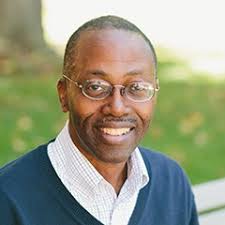
Kevin McGruder, author of Philip Payton: The Father of Black Harlem
During the 1990s, Kevin McGruder served as the director of real estate development for the Abyssinian Development Corporation, a nonprofit church-based organization in Harlem, and he wrote a book about race and real estate in Harlem. In Philip Payton, McGruder’s first biography, he tells the life story of the Black real estate entrepreneur who played a central role in Harlem’s transformation during the early twentieth century. McGruder told interviewer Eric K. Washington: “When Payton and his other colleagues buy property, they’re successful in doing that, and Booker T. Washington sends a telegram to Payton congratulating him on his efforts, he says, for the race and for your investments. That puts Payton on the map. …I would say to approach it [research] carefully and think about what resources you’re going to have available. That if somebody didn’t leave records, kind of being creative in thinking about where one can find that person in other records.” FULL EPISODE
On Searching for a Subject's Inner Life
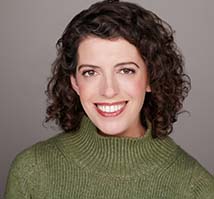
Molly Ball, author of Pelosi
John A. Farrell interviewed Ball, who said: “The one sort of big overarching element of the narrative that didn’t fall into place until relatively late in the reporting process was the sort of final arc. You know, mine is not the first biography of Nancy Pelosi. …She’s a tough interview. She doesn’t give a lot away. She’s very on message. Maybe some of this is very calculated or strategic, but a lot of this is just personal to her and perhaps generational…she’s just a very private person. She’s not confessional, I’m gonna tell you everything I was thinking. You try every tool at your disposal…I think I only partially succeeded. There’s a certain depth that I was never able to get to. But I don’t feel too bad about that because I’m far from the only one, and even a lot of close friends of hers will tell you that there isn’t a different Nancy Pelosi who turns on when she knows she’s off the record or when she knows she’s among her personal friends. …So that in itself is a psychological insight of sorts. And so you learn those sorts of things even as you feel some parts of your subject are inaccessible from talking to people who’ve known them in a personal capacity. …I really did feel like I learned more about her from watching her in action as it were, than from almost anything that she told me in an interview.” FULL EPISODE
|
|
|
|
CORRESPONDENTS' DESK
When Researching One Project Leads You to the Next
By Jane Lincoln Taylor, U.S. Correspondent
New York Correspondent Jane Lincoln Taylor reported on the semiannual Dorothy O. Helly Works-in-Progress Lecture given at the Women Writing Women’s Lives Seminar on October 18. This year, BIO member Victoria Phillips, author of Martha Graham’s Cold War: The Dance of American Diplomacy, was the lecturer. FULL STORY
|
|
|
|
MEMBER INTERVIEW
Six Questions with Aaron Shulman
What is your current project and at what stage is it?
I’m currently in the very early stages of a new book looking at the creative process from the perspective of the behavioral sciences. I’ve been alternating between research and outlining (and re-outlining, and re-outlining . . .) for the last year and a half and now I’m finally about to start work on the proposal. It’s not a biography in any conventional sense, but the most engaging part so far has been the biographical part, digging into the stories of all sorts of creative people who “think for a living”—writers, artists, lawyers, designers, educators, engineers, etcetera—who I will profile in the book.
Who is your favorite biographer or what is your favorite biography?
That’s a tough one, so I’ll just rattle off a few favorite biographies that jump out at me from my shelf, though there are plenty of others I love: Never a Lovely So Real by Colin Asher (about Nelson Algren), Vera by Stacy Schiff, The Orientalist by Tom Reiss, and David Grann’s The Lost City of Z.
What have been your most satisfying moments as a biographer?
I’m sure this is pretty universal, but my most satisfying moments have been getting access to primary-source documents that few people—or even better, nobody else—has seen. While working on my book about the Panero family, I managed to get in touch with a writer who had helped one of the sons on the proposal for his memoirs, which were never completed or published. We met on the grounds of the medical facility outside Madrid where they had worked on the manuscript (this Panero son, Michi, had a lot of health problems) and after we walked around talking for a while, he just gave me a photocopy of the whole thing. It was very generous. It was only 30 or so pages but it was like no other material I’d come across and helped a great deal with my book.
What have been your most frustrating moments?
My most frustrating moments have been when people who I know are huge caches of stories [but] don’t want to talk to me. This happened with the ex-wife of one of the other Panero sons, who would’ve been like a skeleton key opening new doors to understanding the family better. She was hard to reach, until I finally found a friend of hers on LinkedIn who served as an intermediary. But she said no—not just once but every time I asked her over a couple of years.
One research/marketing/attitudinal tip to share?
Attitudinally, in my career I’m a big believer in the importance of “five-minute favors,” which Adam Grant popularized in his book Give and Take. I’m constantly looking for small ways to proactively help everyone I come across, with no expectation that I’ll get anything back from them, but with the faith that if we help others succeed we all end up a bit more successful. And as someone who spends a lot of time alone, it just feels good to interact this way.
If you weren’t a biographer, what dream profession would you be in, and why?
Chef—because I love eating but, in spite of my best efforts, I’m still a pretty mediocre home cook. That said, I probably couldn’t handle the physical intensity or lifestyle demands of the restaurant industry. So maybe I would be one of those food writers who seek out immersive cooking experiences.
|
|
|
WRITERS AT WORK
Holly Van Leuven
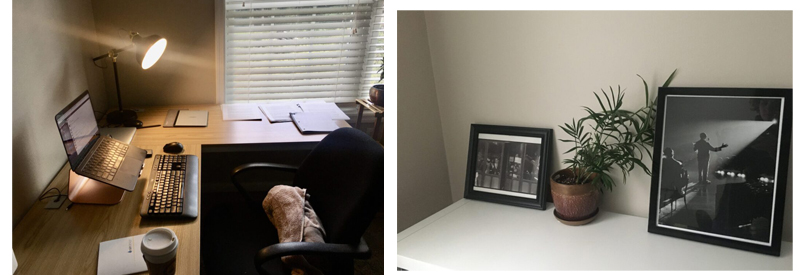
How do biographers do what they do? Or more precisely, how do they organize the space where they conceive of projects, go through notes, write and rewrite their books? With Writers at Work, we offers glimpses into the working spaces of fellow biographers, with the writers describing what works for them and perhaps offering tips on what others should or shouldn’t do.
This month, Holly Van Leuven shows us where she works.
“This section shall become ‘Editor at Work’ for one brief edition, as many have asked: Where exactly is The Biographer’s Craft being put together these days? In the spirit of transparency, I am opening my office. You’ll note that I find ergonomics important—there’s a laptop stand and a lumbar support roll. I also enjoy artwork that pertains to my projects. A favorite of mine is that photo of Louis Armstrong on the right. I purchased it from the Louis Armstrong House Museum, which I visited a couple years after serving as one of the metadata workers helping to bring their entire research catalog online.”
Please share pictures of where you work with us, so we can include them in future issues.
|
|
|
|
AMANUENSIS
What I Learned While Cataloguing an Entire Library of 19th-Century Schoolbooks
by Kim Beil
(from Literary Hub)
. . . Annie Dillard recommends that writers keep a schedule, what she calls “a net for catching days.” A project is even better than a schedule. A project is also a plan, pointing forward in time and pointing out what to look for along the way. A project is an engine for ideas.
By definition, a project is something that looks to the future. It projects. As any writer will attest, research can be thrilling, even addictive. The possibility of discovery is an ever-present lure, the stuff of fables and prizes and hand-drawn maps. Research can also be a never-ending story, as many long-stalled graduate students will testify. Retreating from the world of other peoples’ words into the echo chamber of your own is daunting. That moment, when you finally tip the scale from research to writing, can take years and an earth-shaking worthy of Richter.
Last year when the world shut down, tangible things seemed to evaporate in a cloud of hand sanitizer. I was separated from my family by an impassable distance. I longed for connection to something real, something that had endured. The wear on these books, their elegant ownership signatures, the scraps of paper stuck between their pages all pulsed with life. I longed to reanimate their history—and my own. The project reveals you to yourself.
Here’s the secret: it’s not the project that’s important, it’s the practice. You’re building a habit of curiosity. You learn that if you can write about yet another parsing book, then you can write about anything. And not just that, but you can find anything interesting. An octogenarian photographer I know says that when he holds the camera up to his eye everything becomes amazing. The wonder hasn’t ceased for him. Having a project is similar. It intensifies everything you see. It inspires connections to things you already know and projects you towards things you don’t know yet. FULL STORY
Amanuensis: A person whose employment is to write what another dictates, or to copy what another has written. Source: Webster’s Revised Unabridged Dictionary (1913).
|
|
|
|
KEEP YOUR INFO CURRENT
Making a move or just changed your email? We ask BIO members to keep their contact information up to date, so we and other members know where to find you. Update your information in the Member Area of the BIO website.
|
|
|
MEMBERSHIP UP FOR RENEWAL?
Please respond promptly to your membership renewal notice. As a nonprofit organization, BIO depends on members’ dues to fund our annual conference, the publication of this newsletter, and the other work we do to support biographers around the world.
|
|
|
|
|
|
SIGN UP
For The Latest News In Biography Quarterly
Have you signed up to receive The Latest News In Biography quarterly newsletter? Please subscribe here. We hope you will share the newsletter with your colleagues and readers. Do you have biography news you would like to share for future newsletters? Let us know!
|
|
|
|
THE BIOGRAPHER'S CRAFT
Editor
Jared Stearns
Associate Editor
Melanie R. Meadors
Consulting Editor
James McGrath Morris
Copy Editor
James Bradley
|
|
|
|