|
July 2024 | Volume 19 | Number 5
|

FROM THE EDITOR
The summer of our newsletters being sent as a double feature continues! I am hearing from BIO members that this might be the time of year they have the greatest chance to read for enjoyment, and so this issue of The Biographer’s Craft has a lot of options. Included are recaps of four panels from the BIO Conference: “Who Gets to Tell the Story?,” “Merging Biography and Memoir,” “What Editors Want Today,” and “Mining the Archives for Research Gold.” In the process of editing the pieces, I learned something new from all of them that I am glad to know—and I hope that upon reading them you will have the same feeling.
We also have, at last, the continuation of a feature piloted in the spring of 2022: “Interview with an Archivist.” In this issue, we will hear from correspondent Elizabeth Schott about the Morgan Library’s holdings. We will be featuring additional archivist interviews going forward, to give you all more opportunities to discover research locations of interest.
On a housekeeping note, if you have news or updates that you would like to share with the BIO membership, please email them here.
Sincerely,
Holly
|
|
|
|
FROM THE CONFERENCE
Panel Recap: “Who Gets to Tell the Story?”
 From left to right: Carla Kaplan (moderator); Jonathan Eig, Lizzie Skurnick, and Ilyon Woo (panelists).
By Theresa Anderson
It’s a perennial question for biographers and one that in recent years has even more relevance: “Who gets to tell the story?”
In light of the current debate around cultural sensitivity, what should a biographer consider when crossing boundaries to write about someone outside their own culture, race, religion, or gender? The three writers on this panel discussed the various ways they have dealt with the question, citing extensive research, involving family members of the subject, and including diverse perspectives in shaping the manuscript.
Jonathan Eig, whose first book was about baseball legend Lou Gehrig, said he felt an enormous responsibility with his initial subject—a responsibility that only multiplied with each successive book he has written. His next books were about the inventors of the birth control pill and Jackie Robinson’s first season in Major League Baseball. When Eig, who is white, approached his most recent subject, civil rights leader Dr. Martin Luther King Jr., he gathered around him a council of advisers. He asked friends and scholars of King if they would direct him to sources and look over the manuscript, which left him “a little bit less paralyzed with fear to attempt such an audacious venture.”
As an Asian American writer, Ilyon Woo said she was privy to conversations where people would question the rights of those outside of the culture to tell the story. Concerning her latest book, she said: “I knew the doubts that other people had and I knew that the stakes were going to be that high.” When she began working on Master Slave Husband Wife (37 Ink, 2023), the true story of a couple that escaped slavery in the mid-1800s, Woo knew that she wanted to step into the story respectfully. For her, that meant inviting the descendants of the couple into the project, even if she didn’t know exactly what that would look like.
Lizzie Skurnick, a recipient of two BIO fellowships, is working on a book about her great-grandfather, one of the Black scholars known as “the Talented Tenth” who attended Harvard University at the turn of the 20th century. Skurnick, whose father is Jewish and mother is Black and Catholic, discovered in her research a side of her family she never knew—Texans who were Methodists and several of them preachers, a side of her family she never knew. She said that deep, meticulous research was necessary to give her the confidence to tell this story.
Skurnick said she is glad her book has a Black editor because she wants to be guided by someone who understands the Black experience. Woo agreed—one of the two editors for Master Slave Husband Wife is Black, which she said made a huge difference and underscored the need for diverse hiring in publishing.
Panel members said it was important to see how others have approached their subjects from a different cultural perspective, such as Annette Gordon-Reed, who has written books about U.S. presidents Jefferson and Johnson, and David Maraniss, who wrote a biography about Native American athlete Jim Thorpe.
The moderator of the panel, Carla Kaplan, has crossed boundaries, too, having published an epistolary biography of African American author Zora Neale Hurston. During the discussion, she wondered if the recent Pulitzer Prizes—awarded to Woo and Eig for biography—might reframe the question of nonfiction writers choosing subjects outside their own cultural boundaries.
Kaplan observed that each of the authors approached their subjects with a certain amount of terror, “which is another way of talking about responsibility.” Perhaps, she explained, it’s not a question of a line one can or cannot cross. “It’s a line about doing it right,” she said, capturing the sentiment of the panel. “It’s not whether or not you can do it—it’s how you do it.”
Theresa Anderson is working on a book about five missionaries who were killed in Ecuador in 1956—and about the Amazonian tribe that took their lives. You can follow her work on Facebook and Instagram.
Panel Recap: “Merging Biography and Memoir”
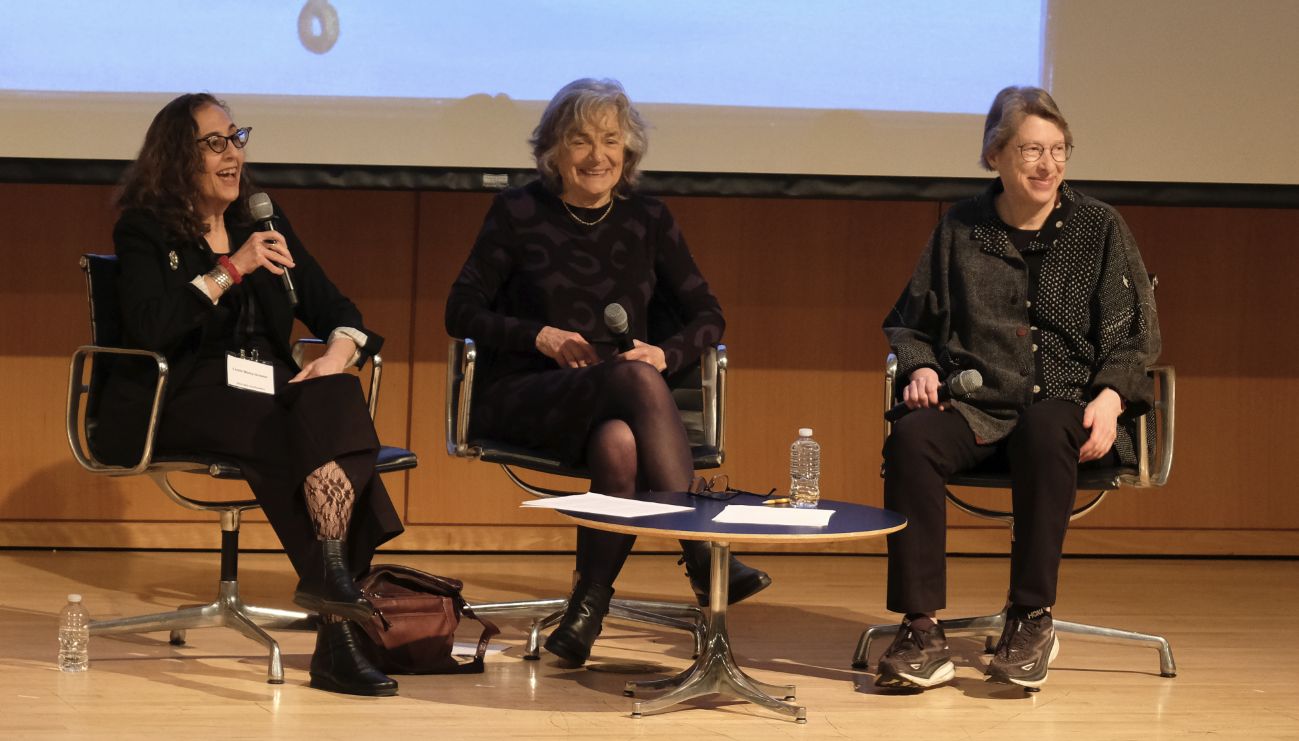 From left to right: Linda M. Grasso (moderator); Marnie Mueller, and Megan Marshall (panelists).
By Holly Van Leuven
The “Merging Biography and Memoir” panel—featuring authors Linda M. Grasso, Marnie Mueller, and Megan Marshall—focused on the intricacies and artistic challenges of life writing by women about women. The panel delved into the concept of “story merging,” in which autobiographical and biographical narratives intertwine to create rich and nuanced stories.
Linda M. Grasso, a professor of English at York College specializing in American and women’s literature, culture, and feminist history, introduced the panel. She opened by defining story merging as an innovative approach where both biography and memoir rely heavily on storytelling. Grasso explained, “In biography, the storytelling is about the subject, another person. In memoir, the storytelling is about the self, which requires the creation of an autobiographical persona. When life writing combines both, a third story emerges, and that’s what I’m particularly interested in.”
Grasso highlighted her book, Equal Under the Sky: Georgia O’Keeffe and Twentieth-Century Feminism (University of New Mexico Press, 2017), in which she explored how O’Keeffe’s life and art continue to inspire contemporary women writers. To illustrate her point, she used examples from works about O’Keeffe, such as Jessica Jacobs’s Pelvis with Distance: A Biography-in-Poems of Georgia O’Keeffe (White Pine Press, 2015). Jacobs’s poetry collection is inspired by her experience living in a place O’Keeffe memorialized in her paintings. The collection combines poems written in the first-person voice of O’Keeffe and her husband, Alfred Stieglitz, with Jacobs’s reflections on her own life. This blending creates a layered narrative in which Jacobs “positions her autobiographical persona in relation to her beloved mentor, Georgia O’Keeffe,” Grasso said.
Emphasizing that the essence of story merging lies in how it can offer new feminist narratives, Grasso quoted feminist author Carolyn Heilbrun: “Only when we look at women’s lives and tell new stories about them . . . will we be able to live those new stories.” This approach allows for a reexamination of well-known figures through the author’s personal experiences. She continued, again quoting Heilbrun: “Lives do not serve as models. Only stories do that.”
Another example Grasso provided was C. S. Merrill’s Weekends with O’Keeffe (University of New Mexico Press, 2013), which combines journal writings with retrospective commentary. This book blends Merrill’s personal reflections with her biographical observations of O’Keeffe, creating a narrative that is both a tribute to the great artist and a chronicle of Merrill’s own artistic journey. Grasso pointed out, “When Merrill entwines her story with the story of her relationship with O’Keeffe, she produces a work of mourning . . . but in the end, given that Merrill’s real and ideal relationship with O’Keeffe resulted in two published books, we can conclude that merging her story with O’Keeffe’s enabled her confident creativity.”
Marnie Mueller, author of The Showgirl and the Writer: A Friendship Forged in the Aftermath of the Japanese American Incarceration (Peace Corps Writers, 2023), shared her journey of writing a hybrid memoir-biography. Mueller, born in the Tule Lake Japanese American high-security segregation camp, wrote about her friendship with Mary Montoya, a performer who had been incarcerated during World War II. Mueller said, “Writing memoir is a daunting and frightening form because the author has to expose herself. In the case of The Showgirl and the Writer . . . I’ve had to expose two people: Mary Montoya and myself.” She detailed the challenges of intertwining her life story with Montoya’s, especially after discovering Montoya had fabricated parts of her past. “I was depleted from the last years of caring for her and wanted to go back to my normal life, but now I needed to know why she had concocted such a story,” Mueller confessed.
Mueller described how her initial resistance to including her own story gave way to an understanding of its importance for providing context and depth. Her book explores the convergences between Montoya’s life and her own, revealing the complexities of identity and the impact of historical events on personal lives. This method allowed her to use fictional techniques while honoring documentary facts, merging their stories with her own voice as a narrator. “My connection to the camps required heavy documentation . . . memory is fugitive, which can be excused to some extent in memoir, but vast amounts of corroborating evidence existed,” Mueller explained.
In discussing her book, Elizabeth Bishop: A Miracle for Breakfast (Houghton Mifflin Harcourt, 2017), Megan Marshall described her innovative approach to merging biography and memoir by alternating between personal reflections and biographical chapters. “My project wasn’t about finding myself through entrustment with a female biographical subject,” she explained. “It was a project about biography. I wanted to show the biographer’s life alongside the biographies, not merged with it. I structured the book to keep the narrative strands separate: brief memoir passages covering the period during which I knew Bishop . . . alternate with much longer biographical chapters on Bishop in which I don’t appear at all.” She highlighted her method of maintaining “proximate distance” from her subject, allowing her to write more empathetically about Bishop’s struggles with alcohol and personal relationships.
Marshall’s works reflect a deep engagement with her subjects, as seen in her Margaret Fuller: A New American Life (Houghton Mifflin Harcourt, 2013), which won the Pulitzer Prize, and The Peabody Sisters: Three Women Who Ignited American Romanticism (Houghton Mifflin Harcourt, 2005). Her upcoming collection, After Lives: A Biographer’s Memoir, set to be published in February 2025 by Mariner Books, continues this exploration of intertwining personal and historical narratives.
During the Q&A session, the panelists discussed the personal costs and rewards of their work. Mueller admitted she was terrified to publish her book, fearing backlash. However, she found that those depicted in her book appreciated the honesty and accuracy of her portrayal. “I beat up on myself a lot in the book . . . I really felt I had to be really, really honest about my own psychological issues,” she said. Marshall shared her unexpected experience with male critics who were very protective of their version of Elizabeth Bishop and “picked on” Marshall’s personal approach to writing the biography. “That was an unfortunate, sad experience for me,” she explained, “because I felt I had given this book my all, and I had opened myself up.”
A key discussion point of the panel was whether there is a formula for when it is appropriate or necessary for authors to include themselves in their narratives. Marshall felt that being candid was essential for authenticity. She remarked, “I definitely felt that I had to be open about my experience with Bishop or it would infect the story in some way. . . . It was a point of honesty.” Mueller added that her books have always involved a blend of personal and historical research, reflecting her life experiences intertwined with broader political and historical contexts.
The discussion concluded with reflections on the evolving nature of memoir and biography, emphasizing the importance of personal honesty and the unique challenges women face in asserting their voices in these genres.
Recap: “What Editors Want Today”
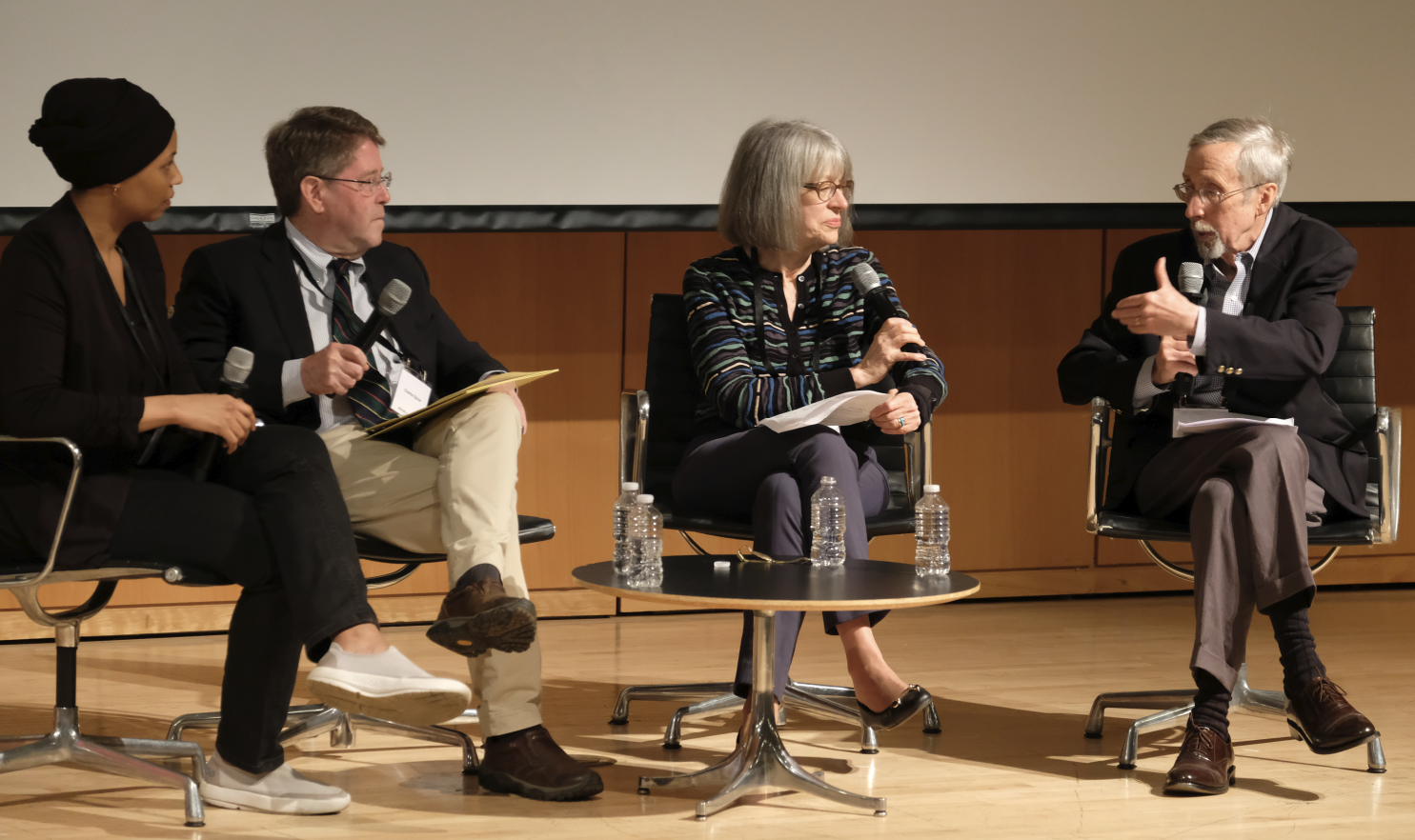 From left to right: Rakia Clark, Charles Spicer, Amanda Vaill, and Bob Bender.
The panel “What Editors Want Today” brought together three experienced editors: Bob Bender, recently retired from Simon & Schuster as vice president and executive editor; Rakia Clark, executive editor at Mariner Books; and Charles Spicer, vice president and executive editor at St. Martin’s Press. The discussion, moderated by biographer and former executive editor at Viking, Amanda Vaill, centered on the elements that make a biography stand out, the evolving publishing market, and the challenges authors face in creating compelling biographies. The conversation went in many directions.
Concerning the key elements necessary for successful biographies, Rakia Clark spoke on the subject of cultural impact. She highlighted her interest in biographies that go beyond a traditional cradle-to-grave narrative. Currently, she is editing Jeff Chang’s Water Mirror Echo, a cultural biography of Bruce Lee that also delves into the history of Asian America. Clark emphasized the importance of a biography’s broader cultural significance, stating that a successful book “gets at the legacy and meaning of something that’s much bigger.”
Another key element is storytelling. Bob Bender underscored the dual importance of the story and the writing. He shared his process of evaluating biographies by asking, “Why this biography and why now?” and emphasized that new revelations or overlooked figures can be compelling. Bender illustrated this point with Ilyon Woo’s Master Slave Husband Wife: An Epic Journey from Slavery to Freedom (37 Ink, 2024), about an enslaved couple escaping from Georgia.
As far as the setting and time period elements in biographies, Charles Spicer discussed how the life itself, the setting, and the time period can make a biography captivating. He gave the example of Wild: The Life of Peter Beard, Photographer, Adventurer, Lover by Graham Boynton (St. Martin’s Press, 2022), in which the writer brings to life the vibrant and controversial circles the photographer and socialite Beard moved in, during the 1960s. Spicer also highlighted Revolutionary Brothers: Thomas Jefferson, the Marquis de Lafayette, and the Friendship that Helped Forge Two Nations by Tom Chaffin (St. Martin’s Press, 2019), a dual biography that vividly portrays revolutionary America and France.
When it comes to finding proposals for biographies, the panelists agreed that most often they come from literary agents, but also highlighted instances where they sought out stories themselves. Vaill told a story of how, early in her career, she read an article in The New York Times Magazine about a female mill worker who unionized a cotton mill in the South. Vaill commissioned an author to write a book-length work, which was published as Crystal Lee: A Woman of Inheritance (Macmillan, 1975), and later was the basis for the film Norma Rae (1976). Vaill said, “I went out and found this because I couldn’t get anyone to send me interesting work at that time because I was too junior and the [publishing] house was kind of in bad repute.” Spicer shared how a compelling obituary in the “Air Mail” e-newsletter led him to commission the Peter Beard biography.
Spicer also emphasized the role of personal networks, recounting how a conversation with a colleague led him to the right author for Wild. Rakia Clark noted that her website, initially set up during her freelancing days, continues to attract inquiries, though not always ones she can pursue.
Concerning the topic of the evolving publishing world, Clark and Spicer both acknowledged the current challenges in the nonfiction market, with declining sales impacting advances and acquisition decisions. Clark explained, “Nonfiction right now is going through a tough period just with consumers; it’s selling less.”
The editors then discussed the increasing importance of author platforms in today’s market. Spicer said, “One of the things that comes up, particularly with nonfiction . . . when you’re trying to buy a book . . . the sales force or the marketing person at your editorial meeting would turn and say, that’s very nice and [an] interesting subject, but what is the author’s platform? . . . How are they going to help market the book?”
“Which, in the old days,” Vaill responded, “we left to the publisher, I will just say.”
New formats, including audiobooks and e-books, are impacting the publishing market. In particular, the panelists highlighted the growing importance of audiobooks, which have seen significant sales increases. Clark noted, “My books, all of them, are over-indexing on audio; people are used to listening to podcasts, and that’s what they’re listening to when they are working out or going for their walk.” Bender added that audiobooks have been cannibalizing e-book sales, which have plateaued or declined.
The panelists discussed the specific challenges authors face in writing biographies. Spicer and Bender both highlighted the potential pitfalls of writing about living people, including access to sources and legal issues. Spicer mentioned the challenge of access drying up, while Bender stressed the importance of securing written commitments for access to private documents. They also addressed the issue of subjects (or authors) becoming toxic, referencing the controversy surrounding the Philip Roth biography by Blake Bailey. The editors agreed that such situations are challenging and require careful handling but are largely a matter of chance since those problems cannot be foreseen at acquisition time.
As far as the structure and style of biographies, during the Q&A a participant asked about writing a biography in reverse chronological order. Bender and Spicer both advised caution, emphasizing the natural structure of chronology in biography should be embraced and noted the potential difficulties of inventing a structure. Concerning the latter, Bender said, “You’re making things much harder for yourself and potentially much harder for the reader.” The other panelists agreed.
The panelists, however, were split on the preference for cradle-to-grave biographies versus a focused period or group biography. Clark expressed her preference for biographies that explore communities or specific periods, while Bender and Spicer noted that the choice depends on the life and story being told.
In response to a question about biographies of unknown figures, Clark and Bender both expressed their enthusiasm for discovering new stories. Clark said, “I love books about people that I don’t know anything about . . . if you can convince me that the person you’re writing about is somebody I should know . . . I’m going to be interested. I think it’s a hurdle to get [marketing and publicity] attention for it, but that’s also part of our job.”
When asked about biographies written by family members, Clark shared her positive experience with Mike Africa Jr.’s upcoming book, On A Move (Mariner Books, August 2024), about the MOVE organization in Philadelphia, in which Africa’s family was involved. Bender also mentioned publishing a memoir by Reeve Lindbergh about her famous parents, highlighting the potential richness of insider perspectives.
In conclusion, in a lightning-round discussion of preferences, the editor-panelists revealed varied tastes. Bender preferred longer, historical biographies, while Clark leaned toward contemporary and group biographies. Spicer emphasized the importance of a fresh perspective or new information in making a well-known subject compelling.
Panel Recap: “Mining Archives for Research Gold”
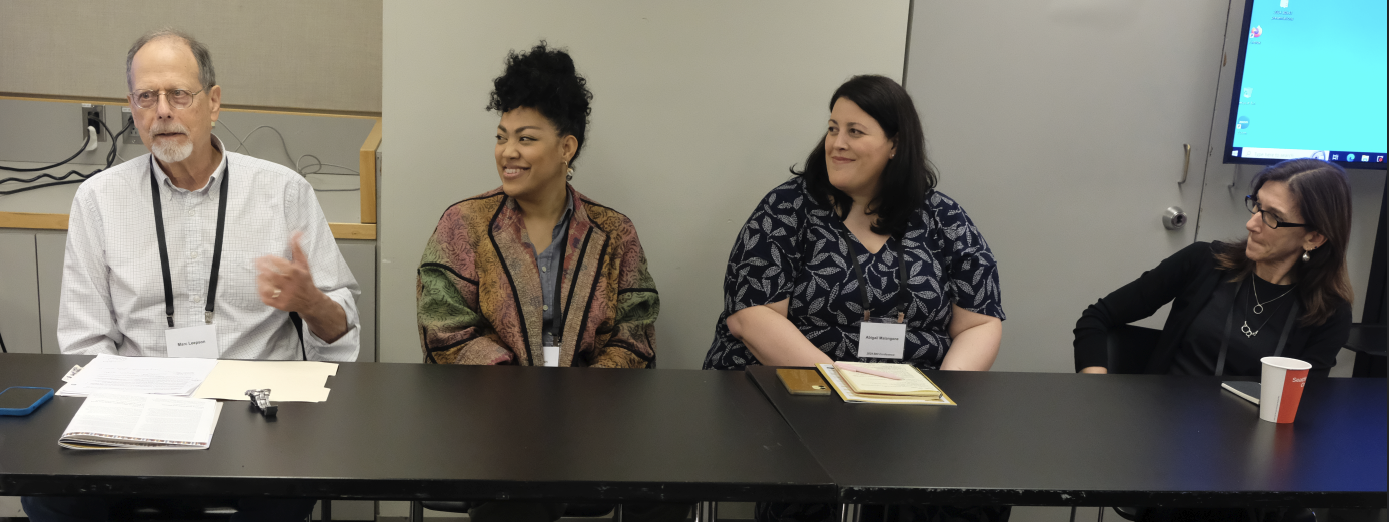 From left to right: Marc Leepson, Barrye Brown, Abigail Malangone, and Nancy Kuhl.
By Mary Chitty
This panel, moderated by biographer Marc Leepson, featured three archivists: Barrye Brown, the curator of manuscripts, archives, and rare books at the Schomburg Center for Research in Black Culture; Nancy Kuhl, curator of poetry at Yale University’s Beinecke Rare Books and Manuscripts Library; and Abigail Malangone, archivist at the John F. Kennedy Presidential Library.
Doing one’s homework before visiting an archive or library is a major part of achieving success with archival research, the panelists stressed. Making the most of these visits is critical, although they noted that research is “hard and challenging” in the best of circumstances. While there are currently no complete directories to archives, the panelists recommended that biographers start with the following sources:
- ArchiveGrid: offers listings for over 1,400 archival institutions and helps researchers looking for primary source materials.
- Social Networks and Archival Context (SNAC): an international cooperative working to build a corpus of reliable descriptions of people, families, and organizations that link to, and provide a contextual understanding of, historical records.
- WorldCat.org: an international library catalog of physical and digital resources.
The archivists also recommended reading webpages of archives of interest and looking for online finding aids in advance of an in-person visit. Curators or reference librarians may be available for telephone or email consultation, but in-person visits may be more productive. Archives usually have a backlog of unprocessed materials and subject matter experts may be able to help you locate elusive content of interest.
Panel attendees had many questions. One asked: “What do you do when an item of interest is not found or a record seems to have a mistake?”; the panelists’ answer: fill out a form, talk to a librarian. Another asked: “How do you cite items in a bibliography”; answer: use a style manual and give enough information to enable readers to get back to the original document. And lastly, “Are archives interested in researcher copies of material?”; answer: probably not, as archives prioritize unique original materials.
The panelists (and attendees) all gave a sense of the excitement and joys of archival research; and archives’ staff members, they said, are happy to be part of this process.
Mary Chitty is a librarian, taxonomist, fact-checker, and lexicographer. She maintains “The Life and Times of Actress EJ Phillips,” a digital biographical research project. You can view it here.
|
|
|
|
ARCHIVIST INTERVIEW
The Morgan Library & Museum
By Elizabeth Schott
During the Special Collections tour of the Morgan Library & Museum at the 2024 BIO Conference, participants were treated to a look at the Paris Review archives, the papers of John Steinbeck, and a preview of the upcoming exhibit featuring Belle da Costa Greene, the Morgan’s first librarian. While on the tour, BIO member Alison Gilbert wondered aloud if there was a way to highlight archivists’ recommendations regarding the Morgan’s holdings in the BIO newsletter . . . and voila!
Philip Palmer, the Morgan’s Robert H. Taylor Curator and Head of the Literary & Historical Manuscripts and Archives, and Associate Curator Sal Robinson, were willing to kick off this series.
How do you access the collection?
The collection can be accessed by making an appointment in the Reading Room via the online form linked here. Images of collection items that have been digitized and are available online can be found here.
What is your favorite overlooked archive?
The Edward Wagenknecht Collection is rarely used but full of exciting material. Wagenknecht (1900–2004) was an American critic and professor specializing in 19th-century literature, but he was also deeply interested in the emerging art of cinema and wrote extensively on that topic. In the course of his research, he developed relationships with major players in the worlds of cinema and theater, and the Wagenknecht Collection contains many personal letters from individuals like Lillian Gish, Mary Pickford, and Ellen Van Volkenburg, a founder of the Little Theatre Movement and a pioneer in puppetry.
What’s your newest, “shiniest” archive?
The Eugene Victor Thaw Papers, 1915–2018 (MA 23786). Thaw was a collector and art dealer who handled a wide range of artworks, from Old Masters to Pollocks, through his New York gallery (originally called The New Gallery and then E. V. Thaw & Co.) in the second half of the 20th century. This archive is an important source for provenance research on paintings and sculpture, and joins the Pierre Matisse Gallery Archives—one of our most heavily used archives—at the Morgan in that area.
Which institution should we contact next?
The William Andrews Clark Memorial Library at UCLA (Rebecca Fenning Marschall is the archivist).
Elizabeth Schott is at work on Dorothy Liebes: A Midcentury Modern Woman Weaver. You can contact Schott here.
|
|
|
|
PITCH YOUR ARTICLE
Would you like to see your work featured in The Biographer’s Craft? Simply fill out this form to submit your pitch for consideration. Remember that features should be focused on the art and craft of biography, should not be promotional, and must be written by BIO members. Submit your pitch here.
|
|
|
|
KEEP YOUR INFO CURRENT
Making a move or just changed your email? We ask BIO members to keep their contact information up to date, so we and other members know where to find you. Update your information in the Member Area of the BIO website.
|
|
|
MEMBERSHIP UP FOR RENEWAL?
Please respond promptly to your membership renewal notice. As a nonprofit organization, BIO depends on members’ dues to fund our annual conference, the publication of this newsletter, and the other work we do to support biographers around the world.
|
|
|
|
|
|
BIO BOARD OF DIRECTORS
Steve Paul, President
Heather Clark, Vice President
Marc Leepson, Treasurer
Kathleen Stone, Secretary
Michael Gately, Executive Director
Kai Bird
Natalie Dykstra
Gretchen Holbrook Gerzina
Carla Kaplan
Kitty Kelley
Diane Kiesel
Sarah S. Kilborne
Linda Leavell
Heath Lee
Susan Page
Tamara Payne
Barbara Lehman Smith
Will Swift
Eric K. Washington
Sonja D. Williams
ADVISORY COUNCIL
Debby Applegate, Chair • Taylor Branch • A’Lelia Bundles • Robert Caro • Ron Chernow • Tim Duggan • John A. Farrell • Caroline Fraser • Irwin Gellman • Michael Holroyd • Peniel Joseph • Hermione Lee • David Levering Lewis • Andrew Lownie • Megan Marshall • John Matteson • Jon Meacham • Marion Meade • Candice Millard • James McGrath Morris • Andrew Morton • Hans Renders • Stacy Schiff • Gayfryd Steinberg • T. J. Stiles • Rachel Swarns • William Taubman • Claire Tomalin
|
|
|
THE BIOGRAPHER'S CRAFT
Editor
Jared Stearns
Associate Editor
Melanie R. Meadors
Consulting Editor
James McGrath Morris
Copy Editor
James Bradley
|
|
|
|